

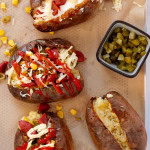
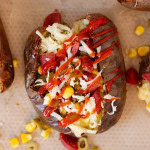
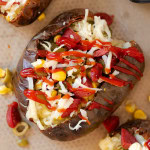
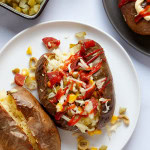
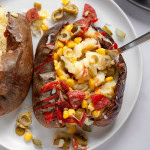
Turkish baked potatoes (kumpir) are undoubtedly one of the most comforting street foods around! Nothing beats it on a cold rainy day! A kumpir is a fluffy baked potato with a crispy shell whose flesh has been mashed to perfection with butter and lots of cheese.

You then choose from what seems an unlimited array of delicious toppings what you want to be placed over the top. Turkish baked potatoes are convivial, fun, warming, and really easy to replicate at home! Bring your toppings of choice to the table and let everyone help themselves and build their own kumpir potato.
Go to:
Kumpir
Kumpir used to mean potato, especially in the Central Anatolia region. Then, in the 90s, the term “kumpir” became more widely used to designate the loaded cheesy baked potato instead. Nowadays, people mostly use the word patates for a potato. The shift probably happened in parallel with the growing popularity of kumpir as a street food. The nineties aren’t that far off, so, all things considered, Turkish baked potatoes are a relatively recent phenomenon in street food.
The baked potatoes sold in Turkey are wrapped in aluminium foil and baked in special ovens. Once cooked and slit open, another half of a potato (or all of it) is added to increase the quantity of potato flesh per kumpir. The flesh is then quickly mashed until completely smooth, and butter and cheese are added. Margarine can be used as a substitute for butter to keep costs low.
People tend to associate Turkish baked potatoes with Istanbul, but you can certainly find them in every Turkish city. I would be remiss if I didn’t mention that kumpirs are actually popular throughout the Balkans, not just in Turkey, although the name and toppings can vary. The good news is that you don’t need to travel all the way to Turkey to eat Turkish baked potatoes. They are really simple to make at home. Honestly, the most difficult part is deciding what you will put on top.
🥔 Potato
BEST POTATO TYPE
If you want fluffy Turkish baked potatoes, you need to use floury potatoes, such as Russet or Idaho potatoes in the US, or King Edward or Maris Piper in the UK. Floury potatoes, also called starchy potatoes, are high in starch and low in moisture. They are perfect for baking because they break down easily during cooking, thus making them easier to mash. Thanks to their dry texture, they also absorb the fat from the butter and cheese more effectively. The inside of a kumpir should be very smooth, so for the fluffiest result, opt for a floury potato.
If all you can find are all-purpose potatoes (for example, Yukon Gold in the US or Desirée in the UK), you can use them to make Turkish baked potatoes. However, as they are less starchy, the resulting mash will be denser.
⚠️ Waxy potatoes don’t work at all for this recipe. Their high moisture content prevents them from breaking down easily. Waxy potatoes are prized for retaining their shape once cooked. It’s all well and good for a potato salad or a gratin, but it doesn’t do you any favor when you press down on their flesh with a fork to try to make a fluffy mash. They also don’t absorb dairy very well.
BEST POTATO SIZE
You can use medium-sized potatoes to make kumpir, but traditionally, Turkish baked potatoes are made with large potatoes. Large potatoes are not easily available where I live, so I use whatever I can find. The weight of the potatoes I use to make this recipe usually ranges from 340 g to 475 g per potato (12 oz to 17 oz per potato). Any potato bigger than that would take forever to cook in a normal oven anyway.
The potato kumpir you get in Turkey looks impressively huge, but they are kind of cheating by adding extra potato flesh from another cooked potato. Listen, bigger doesn’t necessarily mean better. It’s all a bit of a show, especially with the prominence of social media nowadays. It became about who’s got the biggest kumpir with the tallest amount of toppings plopped precariously over the top. Honestly, grab whatever the largest potatoes there are where you shop, and you’ll be in for a treat either way.
🧀 Cheese
KAŞAR PEYNIRI
Traditionally, grated kaşar cheese is the cheese used to make Turkish baked potatoes. Kaşar peyniri is a medium-hard yellow cheese made with cow’s milk. It tastes pretty mild, which is why it’s often served for breakfast. It also melts really really well, so it’s a popular addition to grilled sandwiches and pides (Turkish “pizza”).
Kaşar peyniri might be labelled tam yağlı taze kaşar peyniri, which means full-fat fresh kaşar cheese. The best way I can describe the taste and texture of kaşar cheese is to imagine a less salty Babybel.
There is an aged version called eski kaşar peyniri, which is saltier and more brittle, but this isn’t what you need for kumpirs. You need the milder and meltier kaşar! So, make sure it’s written “taze” (meaning fresh) on the food packet before the word “kaşar,” not “eski” (meaning old).
SUBSTITUTION
You can make kumpir for dinner even if you don’t have access to a Turkish store and can’t buy kaşar cheese. You can replace kaşar with:
- another cheese that melts well and tastes mild: I find mozzarella cheese to be the best substitute, even if it’s a bit blander than kaşar. The only moment when the cheese can melt is when it is combined with the hot mashed potato flesh. The cheesy potatoes don’t go back into the oven afterwards. So to give the cheese as much chance as possible to melt, you will need to shred it finely. Don’t use the biggest holes of the box grater.
If you use pre-shredded mozzarella, it won’t melt properly due to the anti-caking agents added to the cheese. So either be at peace with that or buy a mozzarella block and finely shred the cheese yourself. It will only take 5 minutes, and the result is so worth it! If you have a choice, keep in mind that low-moisture mozzarella melts more easily.
- a 50/50 mix of sharp cheese (that melts well!) and mozzarella: If you want to get closer to the taste of kumpirs made with kaşar, you might be better off using a mix of a sharp and bland cheese.
After all, mozzarella is blander than kaşar, so I’d understand trying to amp the flavor a bit. Or maybe it’s just because I’m French and eat blue cheese regularly that I find mozzarella to be too bland. Maybe it’s plenty flavorful for you! If you only use mozzarella though, taste the mashed potatoes once you’ve mixed in the cheese to make sure it is salty enough. - a stronger cheese that melts well: I’ve tried the recipe with stronger cheeses like Gruyère or Swiss cheese and I found them to be a bit too strong to work as substitutes for kaşar. The resulting baked potatoes were nice, but they didn’t quite taste like kumpirs. If authenticity is not what you are after, feel free to use them because they are certainly tasty!
📋 Step by step
This is an overview with step-by-step photos. The ingredient list and full instructions are in the recipe card below.
Step 1: Prepare the ingredients
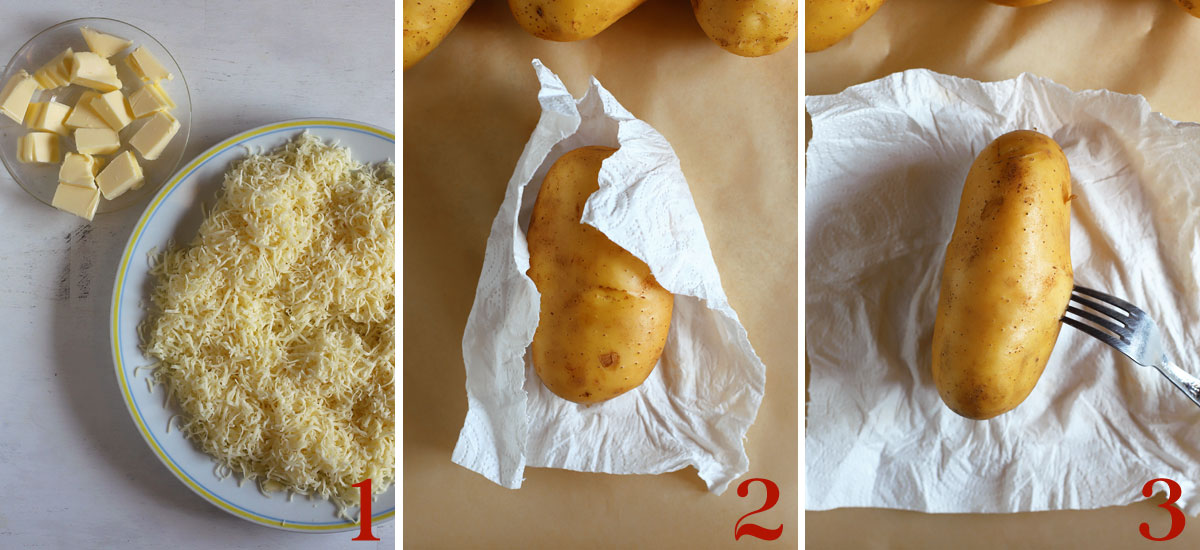
Dice the butter, shred the cheese, and leave them both at room temperature. Rinse the potatoes under running water and dry them well. Prick the potatoes half a dozen times with a fork.
Step 2: Bake your spuds
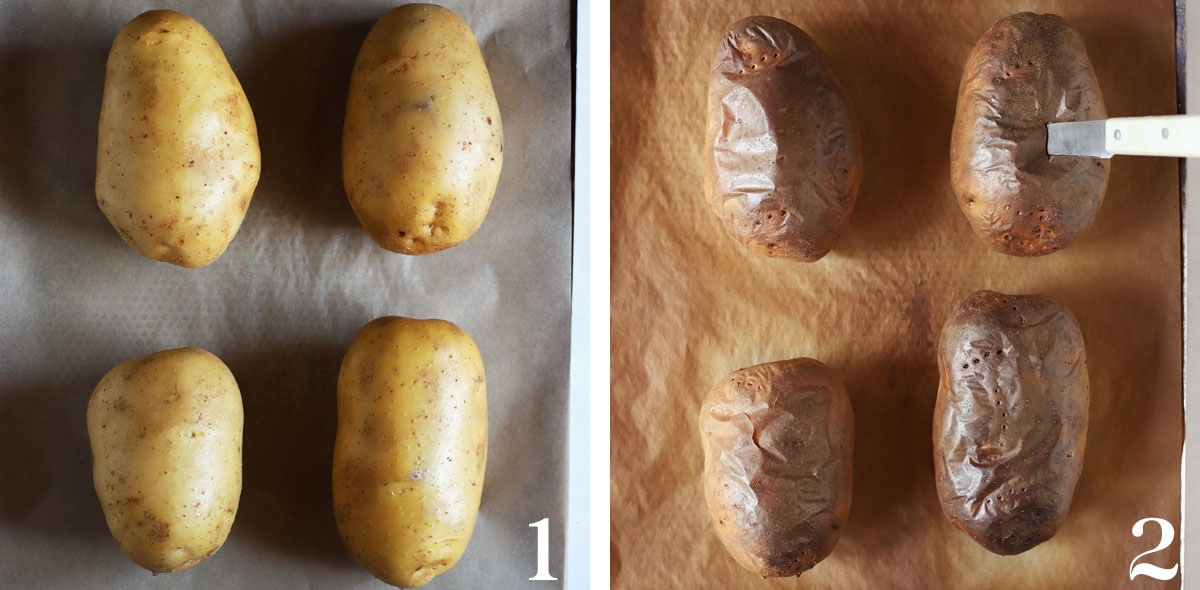
Arrange the potatoes on a lined tray. Bake the potatoes until they are completely tender, about 1h45. If you have a digital thermometer, check the internal temperature of the center of the largest potato. If it registers 97°C (207°F), then you are good to go.
Step 3: Mash, mash, mash!
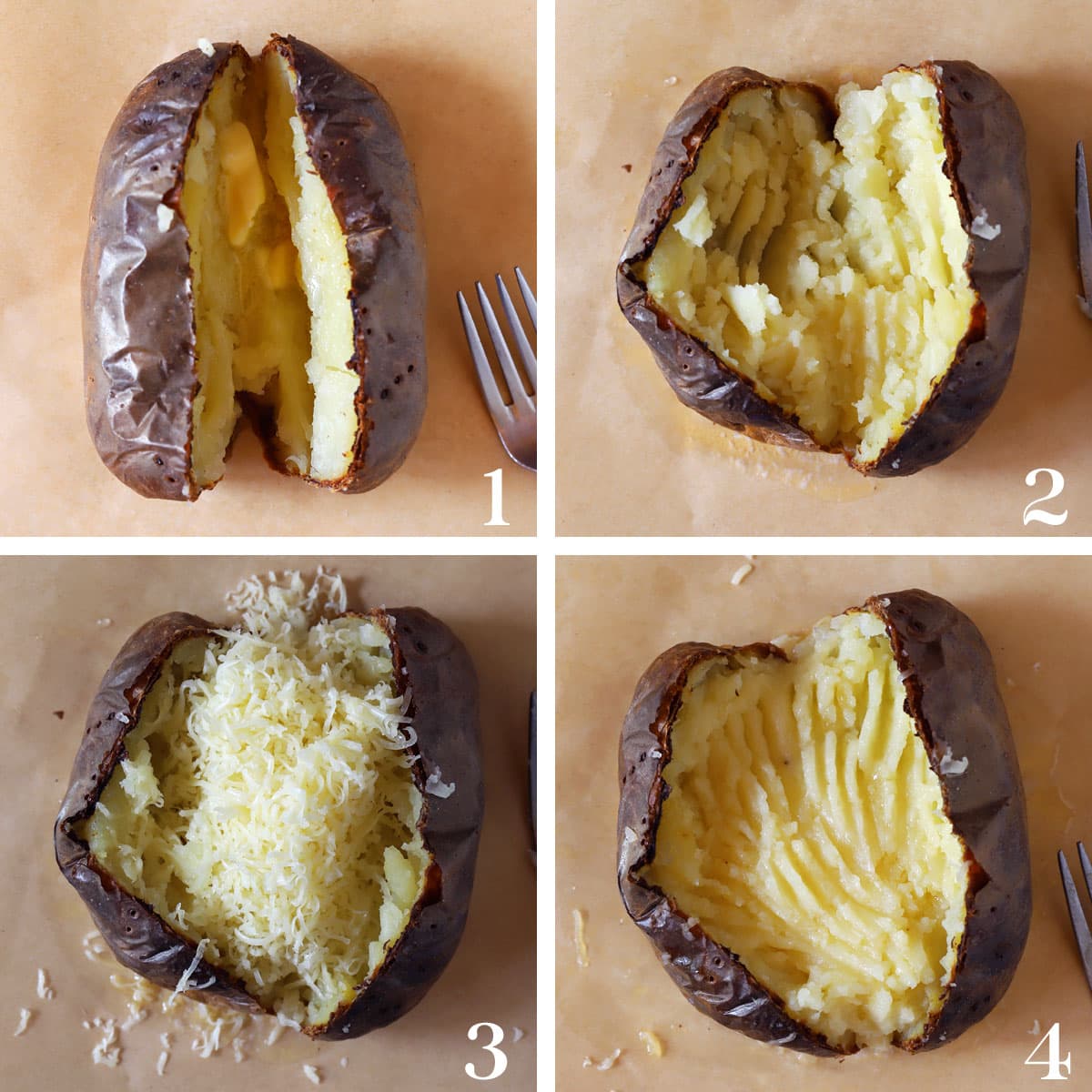
Cut the potatoes in half lengthways, but don’t cut all the way through. Sprinkle the salt over and dot each potato with ¼ of the butter. Mash the flesh with a fork until smooth. Divide the cheese equally over the potatoes. Fold the cheese through the flesh with the fork. Keep at it until the cheese is melted. Reheat the Turkish baked potatoes in the oven for 1 min, if desired, or serve them straight away with your choice of toppings.
🥫 Toppings
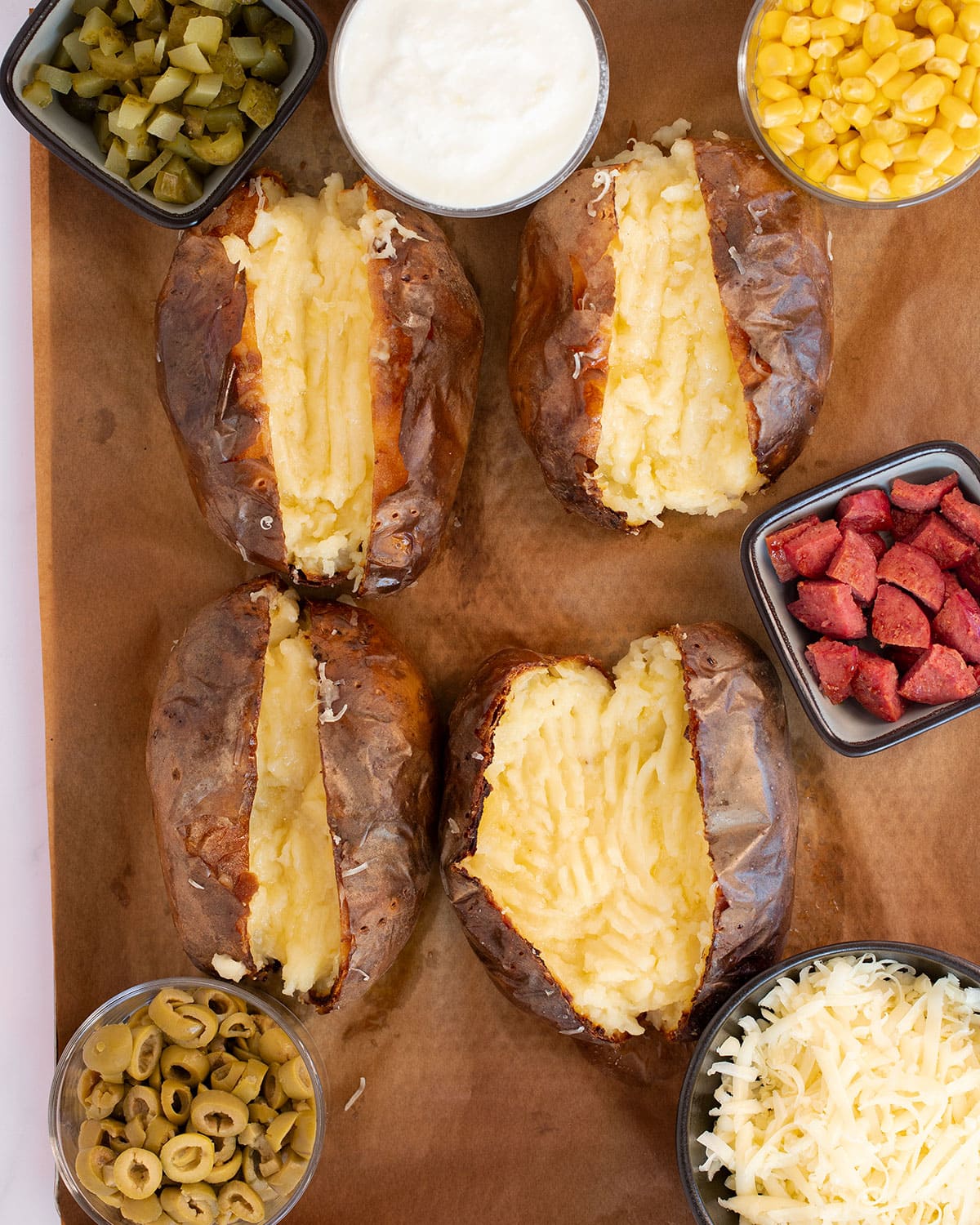
Close your eyes and picture yourself digging into a kumpir. The steam rising from the potato, the pull of the cheese as you take a forkful, the fluffiness of the mashed potatoes! And then consider all the delicious toppings you can add to your Turkish baked potatoes. You can keep it vegetarian, you can pile on the meats, you can add whatever is at the back of your cupboard or fridge! Kumpirs are highly versatile but always downright comforting. Everything tastes great combined with buttery, cheesy mashed potatoes.
TRADITIONAL TOPPINGS
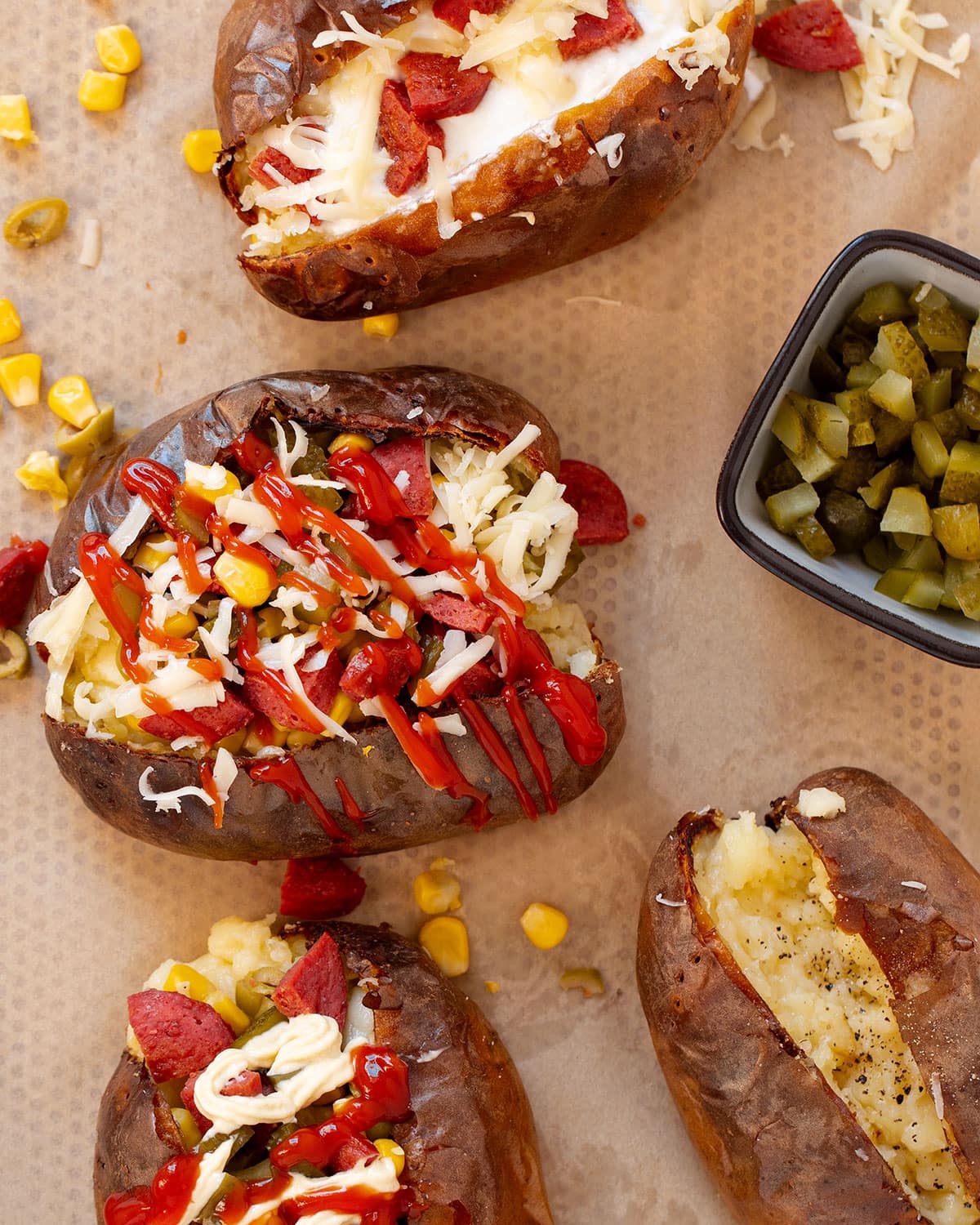
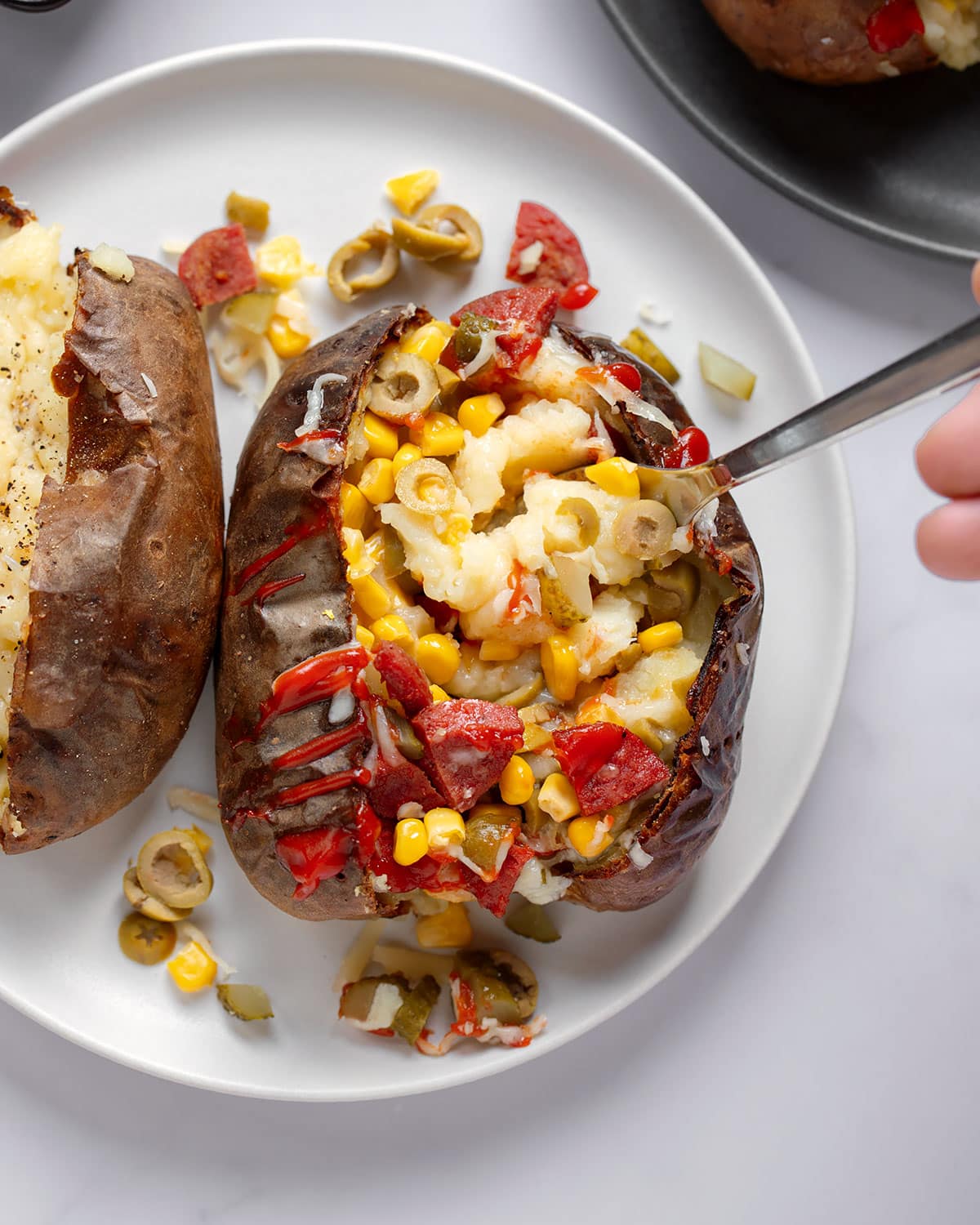
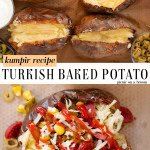
The most traditional toppings for a kumpir are chopped gherkins, sliced olives, corn kernels (drained from a can), chopped sucuk (beef sausage) and rus salatası (the Turkish version of Olivier salad). I know it doesn’t sound very appealing when I put it that way, but, usually, anything that can be drained from a can or a jar can be spotted on a kumpir. Think tuna, peas, mushrooms, and all kinds of pickles. More often than not, a kumpir is drizzled with ketchup and mayonnaise as the final adornment.
Kumpirs hold a special place in my heart because that’s what we ate on one of my first dates with my then-boyfriend (now husband). Dinner and a movie, the classic combo. I can still see us clear as day, riding the elevator to reach the food court, and me using that moment to sneak a good look at him, butterflies in my stomach. I can’t believe it’s been 11 years! Anyway, I had only been living in Turkey for a few weeks and I had no clue about most of the Turkish toppings. So I picked a kumpir topped with ton (tuna) cause that’s the only thing I recognized 😅 (tuna is called thon in French).
NEW WAVE OF TOPPINGS
The kumpir’s increase in popularity kind of turned it into a tourist attraction. To differentiate themselves, restaurateurs began offering Turkish baked potatoes with more and more toppings (in terms of both choice and quantity). You can now find kumpirs topped with anything and everything. Taste is often sacrificed for a crazy looking overflowing kumpir. I guess it looks good on Instagram, but you would be hard-pressed to actually taste the potato underneath when it’s covered with a ton of mezzes.
I’ve seen over-the-top Turkish baked potatoes topped with kısır (bulgur salad), nuggets, havuç tarator (carrot salad), soslu sosis (sausages in sauce), tortilla chips, koftes (Turkish meatballs), and so on. At this point, making the topping is more involved than making the actual kumpir, and it defeats the purpose for me. A baked potato is supposed to be simple fare. A comforting, homely meal that delights you and warms you up. I want to put my kumpirs in the oven and forget about them. Not slave away near the stove, making an array of toppings while the potatoes bake.
But I don’t want to be a killjoy! I can see why these untraditional toppings are fun. I’m simply a bit boring and love a sade kumpir (plain kumpir). I don’t even need toppings! Although I do like it topped with extra cheese, a garlicky yogurt sauce, and some pieces of crispy sucuk (or bacon if I’m out).
Maybe I should embrace all these new toppings and see the kumpir as a blank canvas. I guess as long as people dig into these cheesy fluffy potatoes, it doesn’t matter what they put on top. Every day that you eat a kumpir is going to be a great day! So, have fun, top your Turkish baked potatoes with whichever toppings appeal to you the most. You can’t go wrong.
Turkish baked potatoes
- Prep Time: 35 minutes
- Cook Time: 1 hour 45 minutes
- Total Time: 2 hours 20 minutes
- Yield: 4 servings 1x
- Category: Main course
- Method: Oven
- Cuisine: Turkish
Description
Turkish baked potatoes (kumpir) are fluffy baked potatoes with crispy shells whose insides have been mashed to perfection with butter and cheese. They are then adorned with a delicious array of toppings. No wonder that it’s one of the most popular street foods in Turkey!
Ingredients
For the baked potatoes:
- 60 g butter (½ stick)
- 225 g Turkish kaşar cheese (kaşar peyniri) (8 oz), or replace with finely shredded mozzarella
- 4 large baking potatoes, 340 g to 475 g per potato (12 oz to 17 oz per potato)
- 2 tsp fine sea salt
Traditional topping ideas:
- sliced olives
- chopped pickles
- drained can of corn
- Turkish sausages (sucuk), cooked and chopped
- ketchup
- mayonnaise
- see the post for more ideas
Instructions
- Prepare the butter and cheese. Cut the butter into small cubes and place onto a small plate. Cover the plate with plastic wrap or aluminium foil and leave at room temperature. Shred the cheese onto a plate using a box grater. I use the medium shredding holes, not the largest ones nor the tiniest ones. Similarly, cover the plate with plastic wrap or aluminium foil and leave it to the side until needed. I find that butter and cheese incorporate much better into the potato flesh when they are at room temperature and not fridge-cold.
- Prepare the potatoes. Preheat the oven to 220°C (430°F). Line a baking sheet with parchment paper. Rinse and scrub the potatoes under running water until they are clean of dirt. Dry them well using paper towels or a tea towel. Prick the potatoes all over with a fork about half a dozen times. Listen, I know people say it’s a myth that an unpricked potato will explode in the oven because of pent-up steam inside the potato, but I hate cleaning and I’m not taking the risk. If you think it’s useless to prick your potatoes, don’t prick them. Arrange the potatoes on the baking sheet.
- Bake. Bake the potatoes in the middle of the oven until they are completely tender, about 1h45. If your potatoes are larger than mine, they may need to cook for a longer time in the oven. The skin will be crispy, but you should be able to pierce the center with a sharp knife easily, and the inside should feel tender when you move the tip of the blade around (delicately). If you have a digital thermometer, check the internal temperature of the center of the largest potato. If it registers 97°C (207°F), then the potatoes are ready. Remove the potatoes from the oven.
- Quickly mash the potato flesh. Transfer the potatoes to a large cutting board. Be careful as they are burning hot! As soon as they are on the board, cut the potatoes in half lengthways but not all the way through (if you go all the way, it’s not the end of the world). Season each opened-up potato with ½ tsp of fine sea salt. Dot each potato with ¼ of the cubed butter. Mash the flesh of one of the potatoes with a fork, trying not to tear the skin, until the flesh is smooth and resembles mashed potatoes. Repeat with the other potatoes. Sprinkle ¼ of the shredded cheese over each potato. Fold the cheese through the flesh of one of the potatoes with the fork, using the same mashing movement. Keep at it until the cheese is combined and (mostly) melted. Repeat with the other potatoes and serve straight away with your chosen toppings. Try to work quickly so that they are still hot when served. I usually ask someone to do it with me to go faster because I am no kumpir master (yet).
- Reheat (optional: it’s not traditional and I don’t do it). Traditionally, the kumpirs are served straight away. However, if you think too much time has passed between the moment you took them out of the oven and when they are ready to serve, and that they might be too cold for your liking, you can quickly reheat them in the oven before serving. Decrease the heat to 180°C (355°F) and return the potatoes to the lined baking sheet. Open them well so that their flesh is exposed to the heat better. Return the sheet to the oven for 1 min only. Remove the potatoes from the oven and mash the flesh for a few seconds with the fork to ensure everything is combined. Serve straight away with your chosen toppings.
If you leave them for longer than 1 min, the fat will rise to the surface, the cheese will melt completely and might flow out of the baked potatoes. The texture of the interior will be more akin to a twice-baked potato than a kumpir. After 1 min in the oven, they will be 10°C (50°F) hotter. I am usually not bothered because I don’t find that it makes a great difference and I worry about ruining the kumpir’s traditional consistency.
Notes
You can keep leftover Turkish baked potatoes in an airtight container in the fridge for up to four days. I usually store any leftover kumpir without the toppings, as I don’t think the toppings reheat very well (texture-wise). I would rather top my reheated kumpir with ‘fresh’ toppings, but you do you!
To reheat, preheat your oven to 180°C (355°F) and line a baking sheet with parchment paper. Place the kumpirs on the sheet and reheat them in the center of the oven for 20 min. Alternatively, reheat it in the microwave on high for 2 min. In both cases, you can plunge a knife into the center of the kumpir for a few seconds and then touch the tip of the blade with your finger or your tongue to gauge if the potato is hot enough for you. The texture of the kumpir will change upon reheating, as the cheese mixed into the mashed potato will melt more than it did initially.
(I’ll be honest, most of the time I can’t be bothered with reheating the leftovers and I’ll eat my leftover kumpir cold. It’s pretty good cold too, I swear!)
Nutrition
- Serving Size: 1 kumpir
- Calories: 626 (without toppings)
Do you want to try other traditional Turkish dishes? Here are some of my favorite recipes:


Leave a Reply